

There’s been a lot of debatable stories written about the origins of the kamado and who brought it to the western world.
 Ancient Cooking in Clay & Ceramics
Humans have used clay vessels to cook their food for thousands of years. Archaeologists have found clay cooking pots in every part of the world, and some of the earliest found in China have been dated at over 3000 years old. It is believed that in these egg-shaped clay cooking vessels, the origins of the Kamado are to be found with the clay eventually being evolved and replaced by ceramic materials.
The kamado was invented in China, spread to Korea, and eventually made its way to Japan. The name kamado is the Japanese word for “stove” or “cooking range”. It means a “place for the cauldron”. A movable kamado called “mushikamado” came to the attention of Americans after the Second World War. It is now found in the western world as a Kamado-style cooker or barbecue grill.
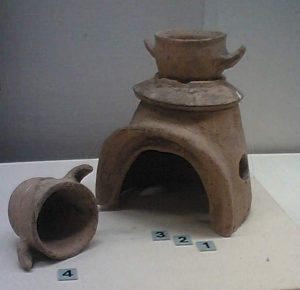
The mushikamado is a round clay pot with a removable domed clay lid and is typically found in Southern Japan.
Since Japanese kamado were introduced from Korea the word kamado itself is rooted in the Korean word gama (가마), Some kamados have dampers and draft doors for better heat control.
 The Mushi kamado
The basic cooking vessel has evolved in different parts of the world and in Japan an interesting device had been developed to cook rice in a unique manner. The Mushi kamado steamed rice was used by families for special ceremonial occasions.
The Mushikamado was made of clay and found in Southern Japan, it consisted of a round and domed base with a similar shaped lid that lifted off the base. Innovations from the basic clay vessel included a damper and a draft door and this later version was fueled by charcoal. A rice pot with a wooden lid would be suspended over the firebox and allowed to steam inside the Mushikamado.

Modern Kamado Barbecue Grills
In the early 1970’s companies in the U.S. started to manufacture ceramic Kamados. These modern Kamados were made of high fire ceramics and had a high gloss ceramic glaze similar to that used by Corning Ware.
The modern Kamado corrected two major problems with its Japanese predecessor.
It did not crack with heat and weather
Rather than being painted, it was glazed.
From here it has been subject to continuous improvement to make it one of the most controllable and forgiving outdoor cooking techniques for the barbecue and smoker enthusiast.


